Fellow boaters on a cruise together were complaining about the failure of the freshwater pump. They were relying on bottled water for drinking and marinas for washing. That reliance is the first safety factor—making sure that the water for drinking, meal prep, and meal cleanup is sufficiently clean. Using bottled water for meals invites short cuts that could create a health hazard.
Upon asking for further information, I was told that the voltage at the pump was below seven volts but that the pump would occasionally work. When I heard about the low voltage, I suggested that it was an electrical problem, not a failed pump. However, a new pump had been ordered for delivery at one of the marina stops. Unfortunately, that wasn’t the fix; the new pump exhibited the same symptoms. I offered to spend some time diagnosing the problem.
The troubleshooting session took a while because some readings would show good battery voltage, and other readings would show low voltage. The replacement pump, connected to the pump circuit with alligator clips, would run for a few seconds, and stop. The fuses and the DC panel breaker were good. Voltage at the DC panel was stable at a good voltage (13.2 volts on shore power at the time we were doing the diagnosis). The new pump ran great when connected directly to the breaker. I eventually decided that the pump’s positive wire needed to be replaced, but I couldn’t identify the exact location or cause.
A length of two-conductor, 12-gauge marine-grade wire was purchased, taking into account the ampacity required for the pump’s draw and distance from the DC panel. (An internet search for “marine wire size and ampacity” provides more information about proper wire size.)
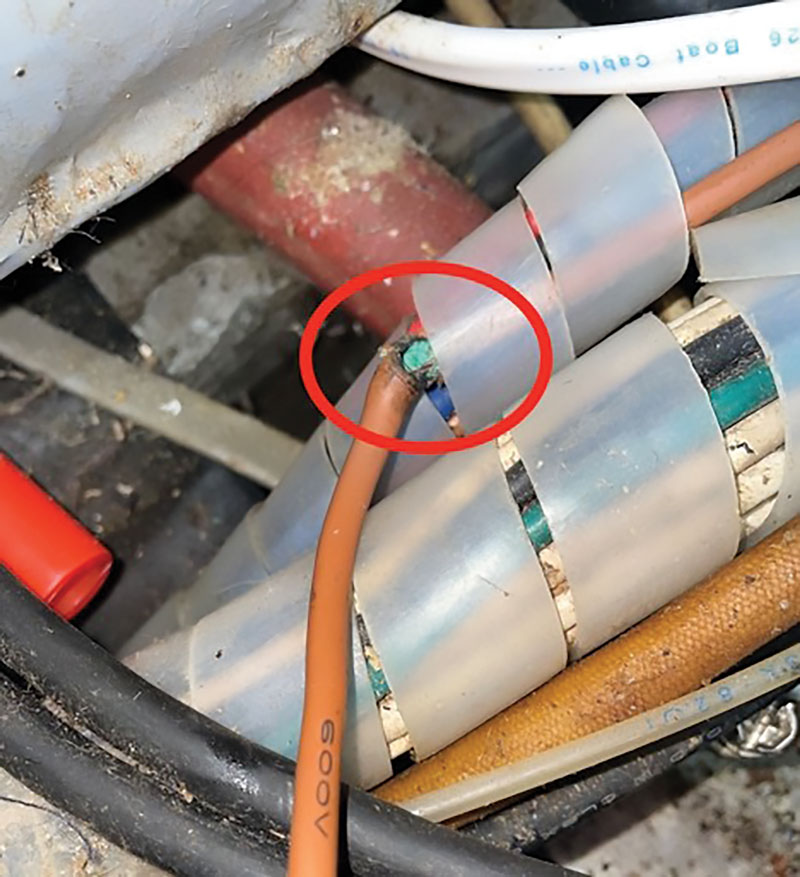
The other boater and I set out to remove the old wire and run new wire. We found a short run from the pump to a spiral loom that carried a bundle of wires into the electrical distribution area. This product is also known as spiral wire sleeving in the McMaster-Carr catalog. I tugged on the positive wire, and that’s when the “Ah-ha” moment arrived—it came apart where it entered the loom. A closer inspection showed that the wire’s insulation had been chaffed through where it rubbed on the edge of the plastic spirals. The wire’s conductor eventually corroded through, as evidenced by the green color highlighted in the photo. The wire had been pulled tight against the spiral loom and eventually failed after several decades of use.
You may be wondering why the wire is brown instead of red. Marine wiring color codes use brown to identify pump circuits. This boat had six different pumps, all using brown wires.
We also noted that the plastic spiral loom was slightly discolored and deformed from heat at its entry into the loom. The freshwater pump runs intermittently, which prevented too much heat build-up. If this corrosion had occurred on a higher duration circuit, it could have resulted in an electrical fire. We didn’t see any other wires with this problem.
In summary, the low voltage at the pump indicated an electrical problem. The changes in voltage and the intermittent operation of the pump were initially confusing, but we were able to determine that the pump was good by connecting it to known-good circuits. Our voltmeter verified the low voltage at the pump while the supply breaker had good voltage. It had to be a failed wire. A new wire is now in place and the freshwater system is fully operational.
About the Author: Terry Slattery, an electrical engineer, started sailing in college; a progression of boats followed. This is one of his monthly safety articles form the Annapolis Sail & Power Squadron’s newsletter, available at aspsmd.org.