The Maryland Dove, a replica of the ship that set sail from England in 1633, is currently undergoing repairs at Dennis Point Marina in St. Mary's County, MD. Before detailing that process, let's discuss the history of the boat's namesake.
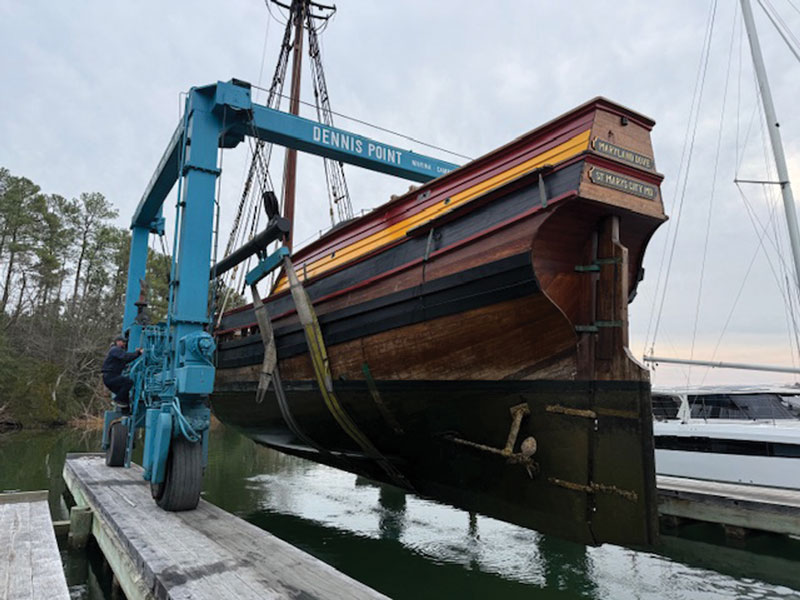
How can you tell the tale of Maryland’s origin without the journey of the Ark and the Dove? It’s a tale of grit, high-seas drama, and the search for a place where “sanctuary” wasn’t just a nice idea, but a lived reality.
The expedition set sail from Cowes on the Isle of Wight, England, on November 22, 1633. Led by Leonard Calvert, brother to Cecil Calvert, the second Lord Baltimore, there were approximately 140 passengers crowded onto the two ships.
The Ark was a massive 400-ton galleon carrying the bulk of the supplies and passengers. The Dove was its much smaller, but quite nimble, 40-ton pinnace, intended for exploring the shallow waterways of the Chesapeake once they arrived.
Their mission was unique: to establish a colony where Catholics and Protestants could live in “peaceable commerce” together, a radical concept in the 17th century.
During the perilous voyage, a massive storm battered the ships. In the howling dark, the crew of the Ark watched the Dove’s lanterns vanish beneath the waves. They feared the little pinnace had foundered. The Ark sailed on, taking a long, southern route via the Canary Islands and the West Indies to avoid the harshest winter gales.
In January 1634, while anchored in Barbados, a small, battered sail appeared on the horizon. It was the Dove. The little ship had survived by turning back to take shelter in the Scilly Isles before eventually chasing the Ark across the ocean. The reunion was celebrated with tears and cannon fire.
The ships finally entered the mouth of the Potomac River in early March 1634. The settlers were awestruck by the “most mighty river” and the blooming dogwoods. They landed on St. Clement’s Island on March 25, 1634. Shortly after, they negotiated with the Yaocomico people to purchase land for their first settlement, St. Mary’s City.
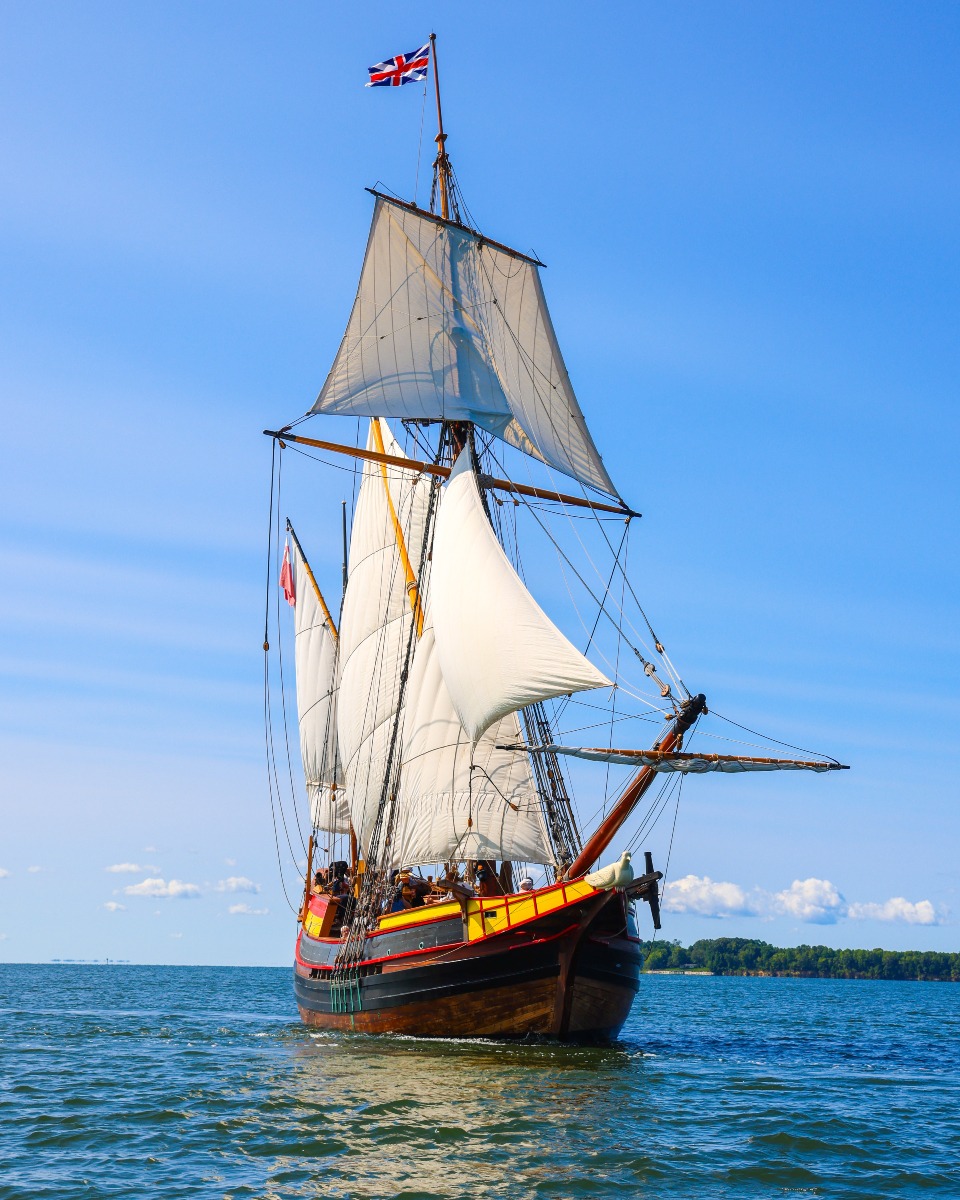
While the massive Ark was the muscle of the 1634 expedition, the Dove was its heart. A 40-ton pinnace—small enough to be dwarfed by a modern tugboat—she was never meant for the open Atlantic. She was built for the rivers, the shallows, and the secrets of the Chesapeake.
The Dove’s story ends with a touch of mystery. In 1635, she was loaded with pelts and timber, bound for England to bring word of the colony’s success. She sailed out of the Chesapeake, past the Virginia capes, and into the Atlantic mists.
She was never seen again. No wreckage was found, and no survivor ever returned. It was as if the little ship, having fulfilled her destiny of delivering Maryland to the map, simply dissolved back into the sea she had so bravely crossed.
The replica Maryland Dove isn’t just a ship; she’s a living museum made of white oak, tar, and thousands of hours of human labor. Constructed at the Chesapeake Bay Maritime Museum in St. Michaels, and operated by the Historic St. Mary’s City Commission, the Maryland Dove serves as a floating ambassador and educational exhibit. She represents the historic vessel that accompanied the first settlers in 1634.
When this mighty vessel is in need of care, she makes the journey to a place where time seems to journey back to meet her: Dennis Point Marina in Drayden, MD.
At Dennis Point, the work is a delicate dance between 17th-century shipcraft and 21st-century engineering.
The Haul-Out
The process begins with the “haul-out.” The Dove is a heavy girl and bringing her out of the water is a breath-holding moment. As the massive 75-ton Travelift slowly hoists her boyer-rigged hull from Carthagena Creek, she looks like a beauty from another era suddenly transported into the modern world.
The Rhythm of the Work
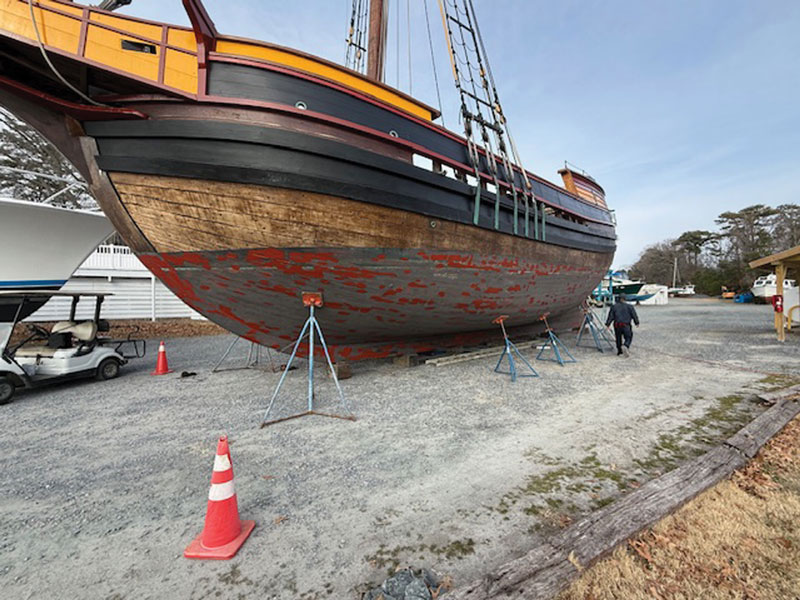
The service team at Dennis Point Marina has extensive experience maintaining a wide variety of watercraft and has proudly taken care of the current Dove as well as her predecessor replica for many years. The boatyard crew moves over her hull with practiced hands. The 2026 work is physical, rhythmic, and detailed:
- Pressure Washing: Remove the “beard” of barnacles and algae that slows her down in the water.
- Bottom Paint: Apply two coats of bottom paint after preparing any bare spots with a priming coat.
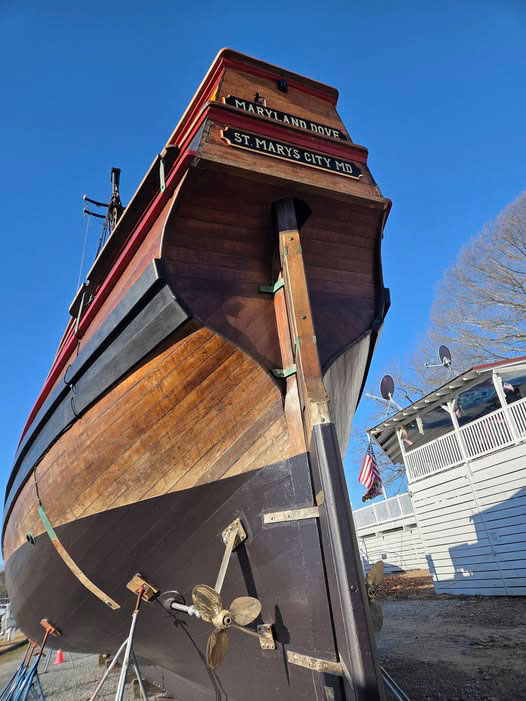
- The Brightwork: Polish running gear and grounding plates to include: propeller shafts, struts, rudder gudgeons, and forward and aft grounding plates.
- Anodes: Replace anodes on these items and add additional anodes on the gudgeons.
- Winterization: Prepare the engines for incoming snowstorms and freezing temperatures.
The Relaunch
When the maintenance is finished a new season awaits. The Dove will be lowered back into the water. For a moment, she’ll sit high and dry, but as the river takes her weight, she’ll awaken. Her timbers will swell, her rigging will tighten, and she’ll be ready to return to St. Mary’s City, looking as sharp as she did when she first cleared the English Channel.
At Dennis Point Marina, we are honored to take care of the Maryland Dove. We don’t just maintain this boat, we’re keeping a piece of Maryland’s soul afloat and remain grateful for the trust Historic St. Mary’s City Commission has placed in us, to help her carry on her mission.
To learn more, visit dennispointmd.com and hsmcdigshistory.org.
By Rick Carter