Each year, hundreds of people are injured, maimed, or killed as result of boat propeller strikes. While approaching a boat from behind to reboard, unsuspecting swimmers can get sucked into the operating boat’s propellers. These events can happen so fast that there is often not enough time to react. Additionally, most boats have boarding ladders mounted extremely close to the boat engines/propeller(s). Here are some tips to minimize risks and stay safe.
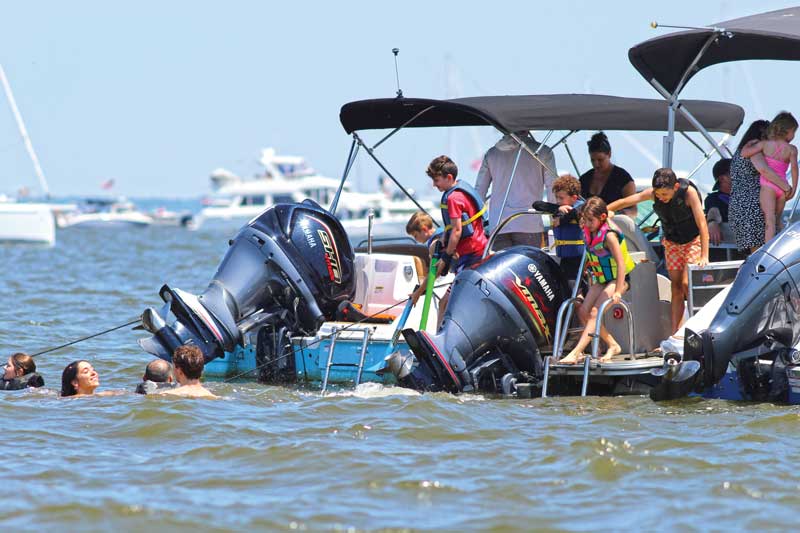
Another potential problem is “bow-riding,” or riding on the gunwale or transom, which is not only dangerous, but also illegal. There have been documented cases where people have fallen off the bow, gunwale, or transom and been dragged under the boat, and were eventually hit with the propeller. Even if the boat is stationary with the engine idling, boat propellers spin and have enough force to injure or significantly maim.
According to the US Coast Guard’s 2024 Recreational Boating Statistics Report, there were 169 propeller strike incidents in 2024, which resulted in 30 deaths and 158 injuries. In 2023, the U.S. Coast Guard (USCG) reported 145 propeller accidents, resulting in 133 injuries and 23 deaths. Unfortunately, these incidents happen more than people realize, and it is for this very reason that this article was written.
For non-propeller “propulsion” systems, as used in boats with jet drives or commonly used in personal watercraft (PWCs), they present a much different threat. An individual who falls off the back of a PWC or an unsuspecting swimmer in the water near/behind a PWC, could suddenly find themselves extremely injured if the operator decides to hit the throttle at that very moment. The amount of force coming out of the jet propulsion nozzle is enough to cause significant injury.
US Coast Guard guidance states: NEVER reverse your boat to pick up a passenger. Always stop, turn around, and SHUT OFF the engine before pulling someone to safety. It is NEVER safe to board or exit from the water while engines are idling because the propeller may continue to spin even when the boat is in neutral. If not in an enclosed cabin, using an engine cut-off switch, which is a lanyard connected to the boat driver and the other end to an engine cut-off switch on the console, can save the boat driver’s life if thrown overboard. This can be the result of a sudden imbalance, rogue wave, or an unavoidable slip and fall overboard.
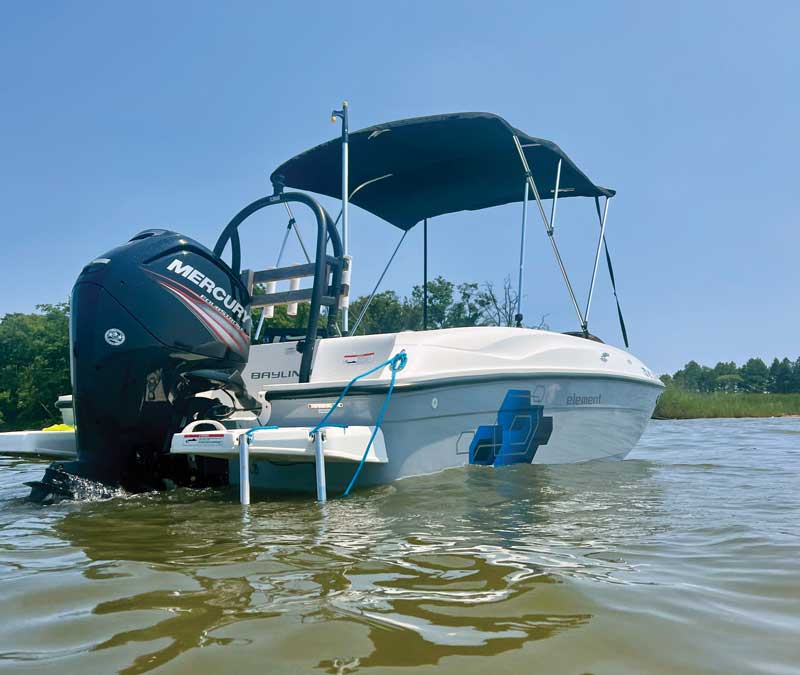
There have been numerous cases of boat operators thrown overboard, while the engine is still running, who are hit and killed by their own boat, as the boat sometimes enters a circular path with no one onboard. This is commonly known as the “circle of death.”
As a boat operator, you are responsible for every person and incident which occurs on your boat. Failure to keep a proper lookout, especially at night, contributes to a significant number of boating accidents. A person in the water without a personal flotation device (PFD), is extremely hard to see, in both extremely sunny days and at night, as only their head is above water. The height and timing of waves could even cover their head, making visibility extremely limited and challenging.
The best guidance regarding your boat’s propeller is this: Don’t run the engine when people are in the water and/or near the boat. Keep a sharp lookout for other boaters engaged in various water sports, like scuba diving, tubing, water skiing, wakeboarding, kayaking, etc. It is important to stay at least 100 feet away from a Diver Down Flag.
Here are some other things you can do to minimize propeller strikes and propulsion unit nozzle injuries:
- Before starting the engine, the operator should look around the boat propeller or PWC propulsion nozzle areas. Ensure no swimmers are in the water.
- Everyone onboard the boat should be aware of where the first aid kit, fire extinguisher, and radio are located, and go over how to make a May-Day call.
- Prior to leaving the dock, have a discussion on the dangers of propellers, for both starting engines, while leaving, and returning to the dock.
- Never permit passengers to ride on the boat’s bow, gunwale, transom, seatbacks, or other locations which increase the likelihood of falling overboard.
- Establish and communicate rules for swim platform use, boarding ladders, and seating areas.
- Consider installing an engine cut-off switch if your boat doesn’t have one already installed (depending on the size and type of boat, this may be legally required).
- Make sure everyone is wearing a PFD at all times, especially at night. (A VHF radio, whistle, light, and mirror should also be tethered to the PFD. A VHF radio does little good if you go out alone, fall in the water, and the VHF radio is on the boat and not accessible.)
- Use of propeller guards, or ringed propellers, are very effective in preventing injury or death.
- Have people in the water stay away and be aware of propulsion unit nozzle dangers. Never congregate around propulsion jet nozzles.
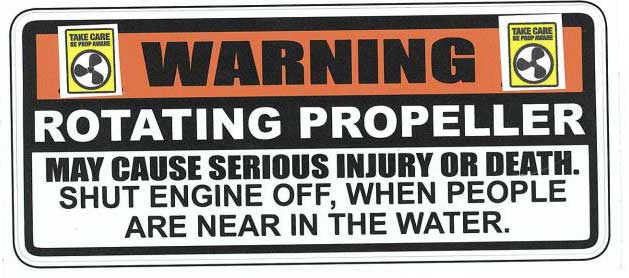
- As reported in the USCG Boating Accident Report Database (BARD) reports, and information obtained by Mr. Polson (propellersafety.com), and in an effort to reduce these incidents, it may be beneficial for boat rental facilities to address these issues to potential boat rental operators during initial familiarization training, and provide a warning sticker at the helm that says: “Danger/Propeller Strike Warning. Do not operate engines with swimmers in the water.”
By Steve Gershman, Maryland DNR, Natural Resources Police Reserve Officer