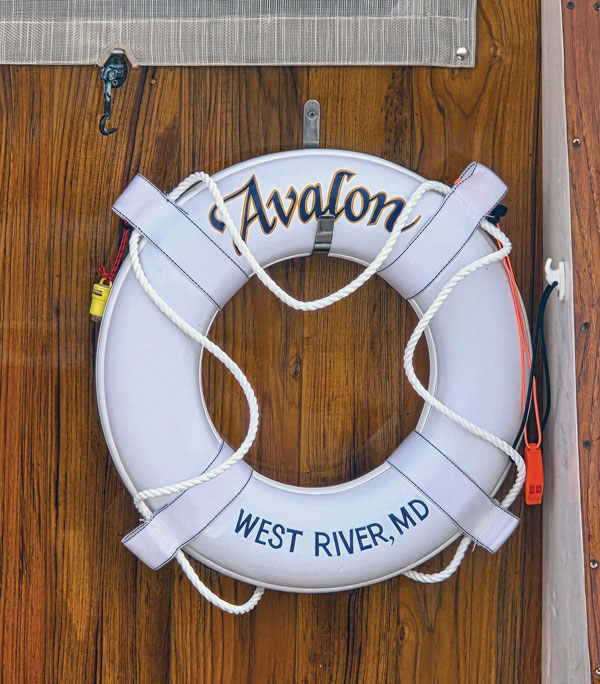
Bruce Ogden is no stranger to classic boats—he currently owns several, including a 1973 Lyman Hardtop Sleeper, a 1975 Boston Whaler Newport, and a 1974 Cape Dory Handy Cat. A few of these have even been covered in past Classic Boat articles. This month, we’re taking an in-depth look at Avalon, Bruce’s 1993 Shannon Downeast 36.
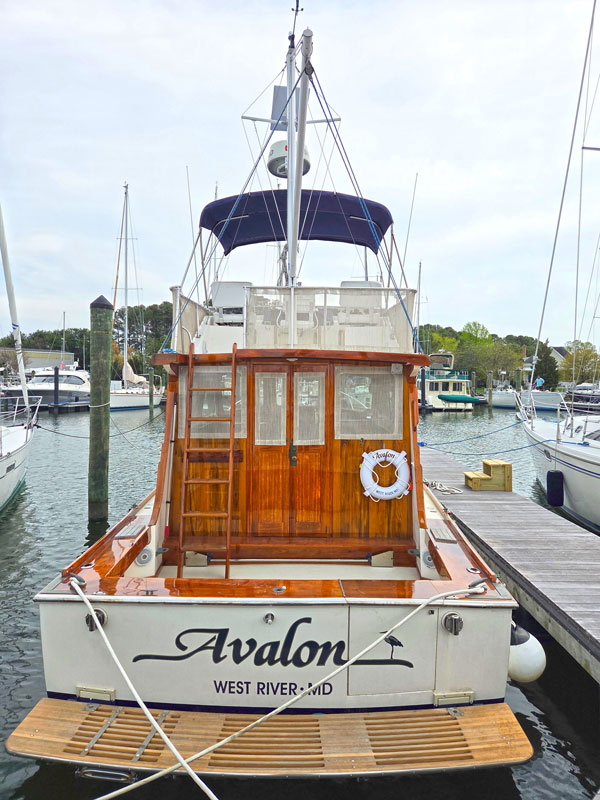
In 2013, Bruce and his wife Jill started searching for another boat. They had been sailing for years but knew they were going to eventually transition to the ‘dark side’ (power). They knew what they were looking for: a downeast flybridge cruiser. After three years of searching all the websites, they saw a listing for a Shannon Downeast 36 that looked promising. The builder had acquired the boat from the original owners and was in the process of completing a hull-up refit.
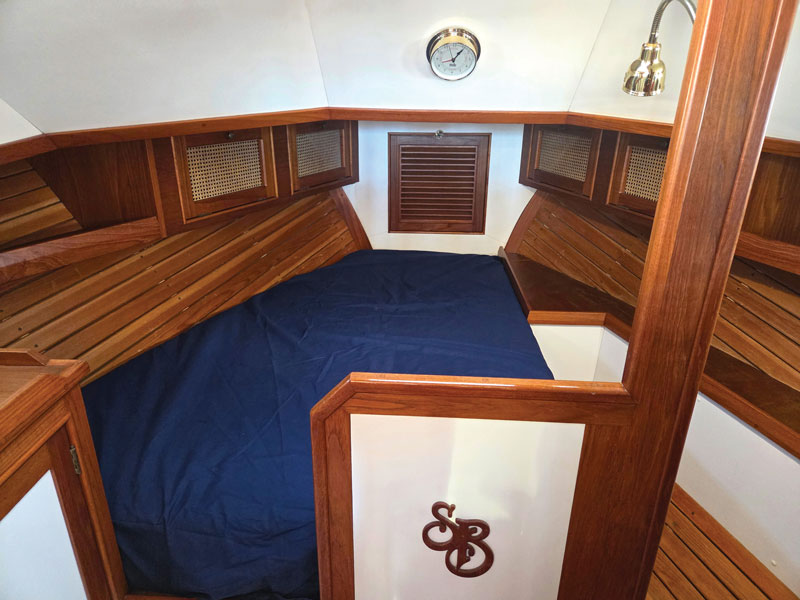
“We fell in love with the sheer at first sight. The boat had the dimensions, features, and the galley down layout we wanted. It had everything we were looking for with exception of a centerline queen berth, but the Pulman queen works out very well. The price was right and it seemed like a great opportunity, so we went for it,” says Bruce. Unfortunately, all did not work out as expected or promised.
“It turned out to be a much more arduous process than I was expecting, accompanied by several surprises and disappointments along the way. If anybody wants to know what not to do when they’re buying a boat, have them give me a call because I made every mistake possible. And I know better!” added Bruce.
One of his best pieces of advice on buying a used boat is to get a marine survey. “Never rely on what the seller tells you, even if they built the boat and have a ‘stellar’ reputation,” he says. Bruce and Jill learned through this ‘adventure’ that critical details had been omitted or withheld from them that would have influenced their purchase decision significantly. Then to add insult to injury, the vessel wasn’t completed as prescribed in the contract; all work stopped and the boat was moved out of the facility. “We were stuck and well past the point of no return, so we took possession, transported the boat to Maryland, and completed the refit locally.”
Avalon had initially been fitted with a marinized Caterpillar 3116 truck engine. Bruce realized there were problems, so he talked to the guys at T&S Marine in Crisfield, MD, and replaced it with a remanned Caterpillar 3116. “They were awesome to work with,” he says. “Just golden.”
“Thankfully, things worked out. The boat is complete and everything is new—every mechanical system, every electrical system, all instrumentation, the engine, the upholstery, everything.” So, in the end, Bruce says, they got the boat they wanted in the beginning, and they truly love it.
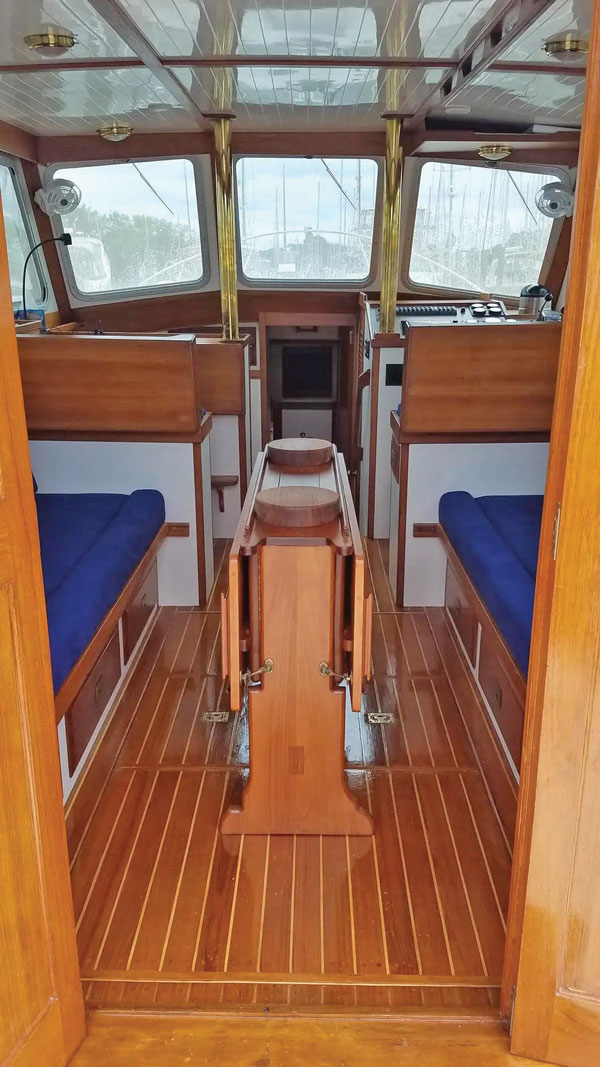
“They just don’t make boats like this anymore,” he added. “Avalon is literally a custom, hand-built boat. There is no fiberglass inside. All the bulkheads, cabin soles, and cabinetry are wood (real wood). We like the classic stuff. It’s just us.”

With the boat completed, they were finally ready to go cruising. “We had completed many sailboat deliveries to and raced around Downeast Maine but somehow, we never stopped to see what we were sailing by. On Avalon, we were able to spend six weeks cruising up to New York, through Hell Gate, Long Island Sound, Mystic, Newport, Gloucester, and all of Downeast Maine, stopping to visit many of the places we had previously just waved at as we passed along the way.”
Bruce described it as an absolutely wonderful experience, so naturally they started looking for the next place to take Avalon. Some friends suggested trying the French version of the Triangle Loop, a popular route that combines parts of the Great Loop with French-influenced areas in Canada. They cruised 1750 miles and ‘locked through’ 100 locks, from New York City, all the way up the Hudson, through the Erie Canal, the Oswego Canal, across Lake Onterio to Kingston, Ontario through the Rideau Canal to Ottawa, down the Ottawa River and to Montreal, down the St. Lawrence to the Richelieu River and the Chambly Canal, down Lake Champlain to the Champlain Canal and back to the Hudson. “It was an incredibly rich trip,” says Bruce. And Avalon performed magnificently. This year will find them heading back to Maine.
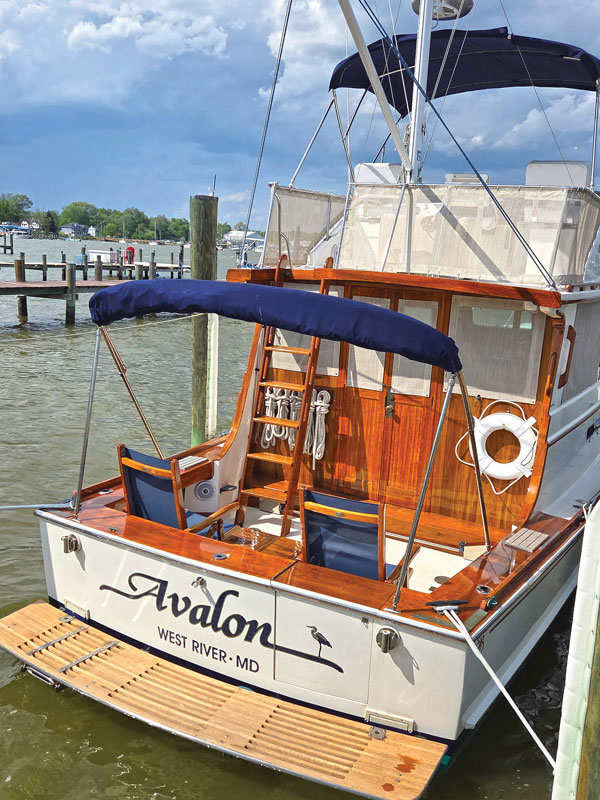
More about Avalon. With teak toe rails, grab rails, cockpit coaming, flybridge ladder, and aft bulkhead, the boat is just beautiful—38 feet overall, 36 feet on deck, 35 feet at the waterline, a beam of 12.5 feet, and a draft of three feet. Vertical clearance is 18 feet with the mast up and 15 feet, six inches with the mast down. Power is provided by a 350-hp Caterpillar 3116. “It’s old school, but it’s simple,” says Bruce. “You don’t need a computer to tune it so once it’s set up, it just goes. It’s been very reliable.”
With the right engine, gear, and wheel, Avalon cruises at 12-14 knots, runs at 17 knots at WOT (wide open throttle), carries 220 gallons of fuel, and 80 gallons of water. Cruising at eight knots, she burns three-and-a-half gal/hr. which gives her a maximum range of about 500 nm. They opted not to put a generator in because as Bruce says, “when cruising, we enjoy the flybridge and if it’s that hot at the end of the day, we’re going to get a slip, plug in, enjoy the AC, and go out to dinner. It’s just easier, more comfortable, and not as noisy.”
Another feature that sold them on this vessel is the second helm station in the salon. “When the weather gets crummy, we come down from the flybridge, get inside, and drive from there; it’s comfortable and dry,” says Bruce.
Regarding typical yearly maintenance, Bruce says it’s the standard stuff every year—oil and filters, cleaning, etc. But he says the biggest maintenance is “the loving care and feeding of the teak.” The aft bulkhead is teak, the coaming all around the cockpit is teak, the toe rails are teak, the grab rails, the eyebrow, the pencil line are all teak, which requires annual attention to keep it looking good. When we spoke back in December, Avalon was getting laid up at Herrington Harbour. In the past, she has spent her winter “spa” months at Campbell’s Boatyard (now Hinckley) in Oxford. “There’s a lot of teak on this boat, and it’s absolutely stunning when finished properly,” says Bruce. “We used to do it ourselves but just couldn’t achieve the results we were looking for. There are a couple of guys at Campbell’s who are absolute magicians with varnish, and they did a fabulous job bringing her back to life. Once you’ve got a good base, teak is pretty easy to maintain. Now, she only requires a couple of annual maintenance coats to maintain her Bristol condition.”
Bruce shared a bit more about the boat’s pedigree. “Avalon is not your typical production boat; she’s a one-off, so you don’t see boats like her every day,” he says. “This hull was drawn by Royal Lowell, who is considered by many to be the godfather of downeast boat design. There’s some interesting history on where the hull mold came from and how Avalon came to be.
“The mold originally started life in the 1970s as a Bruno & Stillman 35. Then it was acquired by Harris Cuttyhunk, who stretched it a foot to 36 feet. Nauset Marine rescued the mold out of bankruptcy to build lobster work boats. Shannon had a customer who wanted a custom downeast cruiser, so they used the mold to build this boat.”
Bruce posits that Nauset laid up about 35 hulls in the late 80s and early 90s, so there aren’t too many still out there and even fewer Bruno & Stillmans and Harris Cuttyhunks. Most were built as workboats, so they didn’t get a lot of interior finish work. To his knowledge, there are only a handful of hulls, in various configurations, that have been finished and fitted out as custom cruising yachts.
“It’s pretty cool,” added Bruce, “describing the history of the boat and the lineage of the boats it came from. It’s a great conversation starter. They just don’t build boats like this anymore.”
As mentioned earlier, Bruce and his wife own five boats. Their Lyman is the only one that is all wood but there’s wood on all their boats (except the RIB). “There is just something very special about wood on a boat. Wood gives a boat soul.”
As we usually do in this column, I asked Bruce if he had any advice for someone considering purchasing a classic boat. His number one suggestion: follow your passion. “If you’ve always dreamed about having a beautiful, classic boat, get one! Life is short and there is no ‘round two.’ Buy the boat!”
We also discussed the costs, which as we’ve heard from several other classic boat afficionados, require a bit of a different mindset.
A boat—any boat—costs money to buy and takes time to maintain. To look at it one way, he explained, a new boat will cost many times more than a classic boat. “All boats require maintenance, but a classic boat will depreciate far less (some actually appreciate), so in the long run, the total cost of ownership of a classic boat can actually be less than that of a new boat. The best part is you’ll have a beautiful classic boat that will turn heads and start conversations. There’s just no better way to make new friends. How do you put a price on that?”
For Bruce and Jill, that makes all the difference. “Everywhere we go, people stop and tell us what a beautiful boat she is. This is one of the truly gratifying aspects of owning a boat like Avalon,” he says. “This is partly because the boat is so lovingly maintained, but mainly because she is just a very pretty boat!
“A boat like this may not be for everyone, but we get as much pleasure out of keeping her looking good as we do cruising on her.” There are always things to work on, but as Bruce says, that’s to be expected. “It’s a boat!”
“We use our boats a lot, and we get as much enjoyment out of looking at them as we do using them. They bring a lot of joy to our lives. We are fortunate to live on one of the most beautiful bodies of water in the world and for us, it only makes sense to have beautiful boats. Life is too short to have an ugly boat!”
It doesn’t get any simpler than that.
Interview by Kaylie Jasinski